
What the Hadza culture can teach us about sustainable living and tourism in Tanzania
Learning from those who live with the land, not on it.
Imagine waking up with the sunrise, not because of an alarm, but because the birds and wind told you it was time. This is the rhythm of Hadza culture: no Wi-Fi, no traffic, no shopping list. Just the sound of fire crackling and the rustle of leaves as someone returns with wild honey. This is life for the Hadzabe people, one of the last remaining hunter-gatherer communities on Earth.
In a world obsessed with progress, speed, and productivity, the Hadzabe offer something profoundly radical: presence. They remind us that living well doesn't always mean having more. Sometimes, it means needing less,and knowing how to live in harmony with what you already have.
Let’s explore what makes their way of life so remarkable, and what it can teach us about true sustainability.
In case we didn't meet yet we’re Mang’ola Life, a community-rooted safari company based in northern Tanzania. We partner directly with Indigenous groups like the Hadzabe to create conscious travel experiences that center people, land, and tradition. This isn’t about checking boxes. It’s about slowing down, listening deeply, and letting ancient wisdom guide the way.
What makes the Hadzabe lifestyle so unique?
One of the last hunter-gatherer cultures
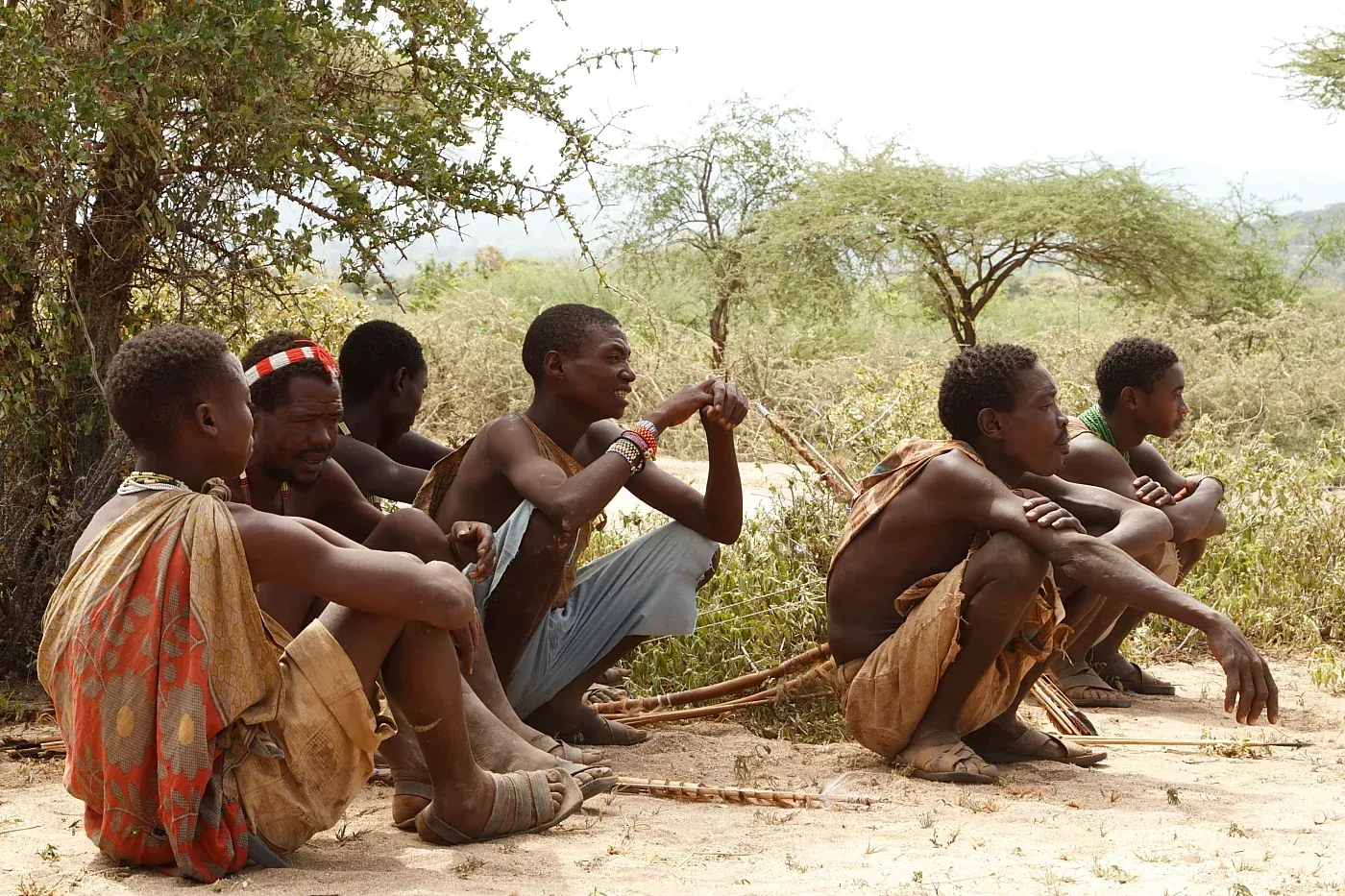
The Hadzabe, also known as the Hadza, have lived in northern Tanzania’s Yaeda Valley for thousands of years. Unlike neighboring agricultural groups, they’ve retained a nomadic, foraging lifestyle, moving with the seasons and sourcing all food from the land.
- Diet: Their meals are fresh from the wild meat from bow-hunted game, roots and berries gathered on foot, wild tubers, baobab fruit, and the most prized delicacy: honey.
- Tools: Arrows are handmade with wooden shafts and metal tips repurposed from scrap. Nothing is wasted.
- Shelter: Homes are built temporarily under trees or in shallow rock shelters. No cement. No gates. Just what’s needed.
- Time: There are no clocks. The sun, the wind, and the needs of the group dictate the rhythm of life.
While many cultures have moved toward industrialization, the Hadzabe remain deeply tied to the land as both teacher and provider. Their lifestyle is not a historical re-enactment, it's an active choice. And it's one worth learning from.
Resisting modern pressures, preserving ancient wisdom
Modernization has reached even the remotest corners of the globe,but the Hadzabe have resisted. Roads, tourism, and land development continue to encroach on their territory, yet they’ve remained steadfast in protecting their autonomy and ancestral knowledge.
Their survival isn’t accidental. It’s intentional. It’s strategic.
- They have secured legal land titles to over 200 km² of territory in partnership with organizations like Cultural Survival, protecting their homeland from outside exploitation.If you’d like to learn more about how this was made possible, you can read about the process and partnerships in this article by Cultural Survival.
- Instead of converting to agriculture or wage labor, many Hadzabe continue to pass on oral histories, traditional hunting skills, and ecological wisdom to younger generations.
- They view sustainability not as a new goal, but as a lived reality, they’ve practiced it long before the word existed.
Their commitment to protecting not just land, but language, memory, and meaning, is a radical form of resistance. And in doing so, they offer a model for how communities might honor tradition while navigating change.
Who are the Hadzabe people of Tanzania?
An introduction to the Hadza way of life
The Hadzabe (or Hadza) are one of the last remaining hunter-gatherer communities in the world, living near Lake Eyasi in northern Tanzania. They’ve inhabited this region for tens of thousands of years, building an intimate relationship with the land,one not defined by ownership, but by profound respect and reciprocity.
With a population of roughly 1,300 people, their language is a unique click language unrelated to neighboring groups. The Hadza don’t rely on farming or herding,instead, they live lightly, moving with the seasons and adapting to the rhythms of nature.To support their sovereignty, organizations have worked to secure Hadza land rights, ensuring future generations can continue this ancient lifestyle.
Living without agriculture or herding
Unlike most communities in East Africa, the Hadzabe don’t plant crops or raise livestock. They gather fruits, tubers, honey, and wild plants; they hunt with hand-carved bows and poison-tipped arrows.
Their lifestyle is guided by seasonal awareness,knowing when baobab fruit is ripe or which bees produce the sweetest honey. This mobility keeps their ecological footprint minimal and their relationship with nature cyclical rather than extractive.
In the Yaeda-Eyasi Landscape Project, where many Hadzabe still reside, community-led conservation efforts have helped protect biodiversity while honoring traditional lifeways.
A day in the life: Hadzabe gatherer-hunter practices
Sunrise foraging: Following the land’s rhythm
Each morning begins with observation,reading animal tracks, scanning treetops for honeybirds, and listening to the wind for signs of where food may be. Hadzabe women typically gather berries, roots, and tubers using digging sticks, while men may split off in small groups to hunt.
There’s no rush. No hoarding. Just what's needed for that day. It’s not just foraging, it’s attunement.
Hunting with purpose and precision
Hadzabe hunters use bows crafted from local trees and arrows tipped with natural poison. Hunts are strategic, respectful, and rooted in understanding animal behavior.
Every animal is approached with intention,never more than is needed, and nothing is wasted. Even bones are used as tools or left for scavengers to complete the cycle.
As conservation partners, Hadzabe hunters work closely with organizations like The Nature Conservancy in helping hunter-gatherers protect their homeland, safeguarding wildlife corridors and keeping ecosystems in balance.
Waste-free living
There are no landfills. No plastics. No excess. What comes from the land returns to it.
Food scraps are composted by nature. Clothing is minimal. Tools are reused. Even storytelling is passed orally, no ink, no paper, just memory.
In a world chasing convenience, the Hadzabe live a reality that feels almost futuristic in its sustainability: zero waste, total harmony.
Seasonal knowledge and ecological wisdom
Following the rain, reading the land
The Hadzabe don’t rely on forecasts,they read the land like a living map. Shifting with the seasons, they follow the rains and blooms to forage only what’s abundant, never what’s at risk. If tubers are scarce, they move. If berries are plentiful, they stay. This way of living ensures that nothing is overharvested, and the land always has time to regenerate.
Their movement isn't aimless,it's ecological intelligence in motion.
The language of the Hadzabe
Oral tradition and place-based memory
Every landscape tells a story, and the Hadzabe remember.
- A tree marks the site of a birth.
- A song holds the history of a drought.
- A trail carries the memory of migration.
Stories aren't just entertainment, they’re survival maps. And in Hadza culture, memory isn’t something you keep in your head, it’s something you carry through land and language, again and again.
What we can learn from Hadzabe sustainability
A relationship with nature, not a resource model
The Hadzabe don’t “use” nature, they live with it. Instead of extracting for gain, they interact with the land in ways that respect its cycles and limits. There’s no stockpiling, no excess, just what’s needed, when it’s needed.
This mindset flips the Western idea of nature as a commodity. For the Hadzabe, the forest is not “owned.” It’s kin.
Embracing slowness and mindfulness
Hadza life flows with natural rhythms, sunrise walks, patient foraging, and stories by firelight. It's not rushed. It's rooted. This slowness isn’t “behind" it’s intentional.
It invites presence, not productivity. It nurtures observation over urgency. And in a world that often glorifies fast and full, their way of life reminds us that slower can mean richer.

Myths and misconceptions about the Hadzabe
Beyond the “primitive” narrative
Too often, the Hadzabe are labeled as "primitive", a word that flattens complexity and reinforces harmful stereotypes. But this framing ignores the truth: the Hadzabe live by choice, with deep intelligence and adaptability.
They are not relics of the past. They're living examples of what it means to thrive without exploiting.
Let’s move from romanticizing or pitying , to honoring and learning.
Why are they not “frozen in time”
The Hadzabe are evolving, but on their own terms. While some younger members may engage with modern tools or schooling, they continue to uphold the values that sustain them: land stewardship, mutual care, and interdependence.
They’re not resisting change, they’re choosing what serves their way of life, and rejecting what threatens it.Their sustainability isn't about the rejection of the new. It’s about discernment. And that’s something we could all practice a little more.
How the Hadzabe are protecting their land and rights
Land conflict and cultural resilience
For generations, the Hadzabe have faced pressure from expanding agriculture, tourism, and shifting land policies. These aren’t abstract threats, they’re lived experiences of displacement and restriction.
Yet, the Hadzabe continue to protect their way of life with quiet resilience.
- Defending ancestral territory
- Refusing unsustainable development
- Reclaiming their autonomy through advocacy
Their strength lies not just in resistance,but in deep-rooted cultural continuity.
Collaborating with allies, not being “saved”
The Hadzabe don’t need rescuing. They need respect.They’ve partnered with local and global allies to secure legal recognition of their land, on their own terms. Community-led initiatives around conservation, education, and storytelling aren’t acts of dependency. They’re affirmations of sovereignty.The real support isn’t charity, it’s listening, aligning, and amplifying.
How to engage with Hadza culture respectfully
Choose ethical, collaborative experiences
Not all cultural experiences are created equal. Some exploit. Some extract. Some stage sacred rituals for quick entertainment.
But truly respectful experiences:
- They are led by Hadzabe themselves
- Honor consent and context
- Avoid spectacle in favor of presence.
As a traveler, your curiosity is welcome, but it must be paired with humility.
Mang’ola Life’s approach to Hadzabe engagement
At Mang’ola Life, we co-create every interaction with Hadzabe communities. Nothing is promised on a schedule. Nothing is performed for cameras.
You’re not just “visiting a community.”, you’re being invited, if the moment feels right. And when that happens, it’s not for your bucket list, it’s for shared connection.
We work slowly, collaboratively, and always with the community’s voice at the center.
The Hadzabe and the future of sustainable tourism in Tanzania
Why conscious travel matters more than ever
Tourism is one of the most powerful forces shaping the future of Indigenous communities and the land they call home.
In Tanzania, that power becomes even more visible. Safari circuits bring thousands of travelers each year, but not all arrive with the intention. Some come to collect photos. Others come to “observe” culture.
But what if we chose differently? What if every traveler became part of a movement, not just a market?
When you choose ethical experiences rooted in community consent, you're voting for a world where:
- Ecosystems are protected by those who know them best.
- Cultural traditions are honored, not commodified.
- Tourism becomes a form of solidarity, not spectacle.
Your presence has power. Use it with care.
Walking lightly, living deeply
The Hadzabe show us that sustainable living isn’t about gadgets or trends, it’s about values.
It’s in the way they follow the land’s rhythm.
They teach through story, not lecture.
In the way they take only what's needed, and give back without being asked.
To travel in their homeland is to be invited into a different tempo. A slower one. A more attentive one. One where meaning is found not in quantity, but in quality.
At Mang’ola Life, we believe in safaris that don’t just visit the world, but engage with it. That move slowly, humbly, and with reverence.
Ready to walk a different path?
At Mang’ola Life, we don’t offer cookie-cutter safaris. We craft regenerative journeys that honor Indigenous wisdom, protect wild spaces, and invite you to travel with heart.
If the Hadzabe have stirred something in you, a curiosity, a longing, a question, follow it.
Walk with us in Tanzania.
Sit by the fire, not behind the lens.
Learn from people who live what the world is still trying to remember.
Because the most meaningful journeys don't just take you somewhere new, they bring you back to what truly matters. Explore ourconscious safari experiences and begin your walk today.

Welcome to Mang'ola life we are a sustainable safari company located in the heart of Tanzania, Africa. Plan your next adventure with us.